
Blog · Oct 21, 2026 · 13 min read
Financial Planning After 40: 5 Rules to Rebuild Wealth

Idowu Nafiu
Financial Strategist
Feeling financially behind at 40? Learn five practical rules for financial planning after 40 to rebuild wealth, grow your career, and gain freedom.
You are 42. You have a steady job, a mortgage, maybe kids in hockey or dance class. Yet at night, you wonder why financial freedom still feels so far away. You check your bank balance and feel a quiet dread. You compare yourself to a coworker with a nicer car or a cousin who just bought a cottage. This is the quiet financial anxiety nobody talks about after 40.
Here is the good news: turning 40 is not a deadline. It is not the finish line for success. In fact, it can be the start of your most intentional chapter yet. Financial planning after 40 is not about catching up to anyone. It is about building real, lasting security on your own terms.
TL;DR: The Fast Answer
- It is not too late. Starting to invest or save seriously at 40 or 45 still allows for meaningful compound growth over a 20 to 25 year horizon.
- Net worth benchmarks are flawed. There is no single correct number for age 45. Your personal expenses, debt, and goals matter far more than comparisons.
- Career change after 40 is realistic when you reposition existing skills instead of starting from zero.
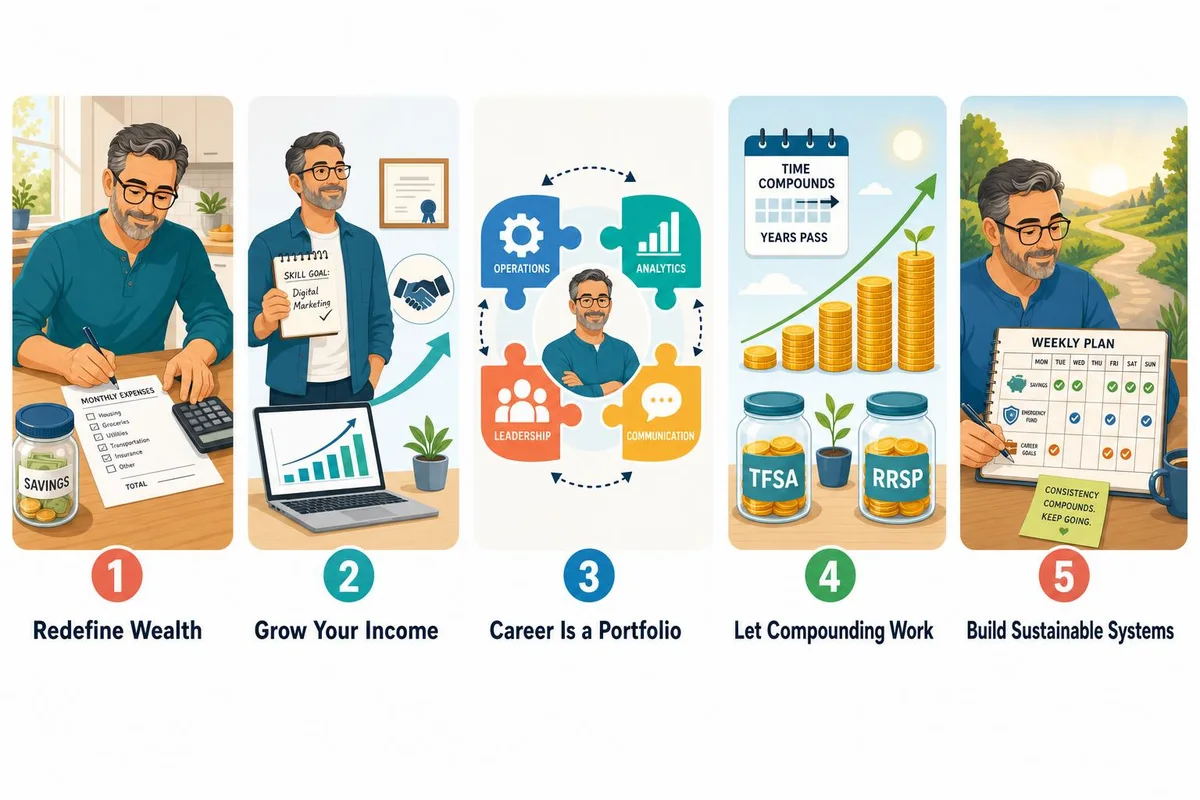
- Five rules matter most: redefine wealth, grow your income, treat your career as a portfolio, use compounding consistently, and build sustainable systems instead of chasing a deadline.
Rule 1: Redefine Wealth. Stop Measuring Success by What Others See
Real wealth is not what people see. It is what sits quietly in your savings account, your investments, and your ability to say no to a bad situation. Financial planning after 40 starts with separating appearance from actual security.
Many Canadians in their 40s carry a heavy mortgage, a leased vehicle, and credit card balances, yet look successful on social media. However, this kind of visible wealth can hide real fragility. If a job loss happened tomorrow, would the lifestyle survive three months?
Financial resilience means having options. For example, an emergency fund gives you the power to leave a toxic workplace without panic. It also gives you room to negotiate, rather than accepting the first offer out of fear.
A Simple Self-Check
Wealth Reality Checklist:
- List your essential monthly expenses (housing, food, insurance, debt payments).
- Calculate how many months your current savings would cover those expenses.
- Identify one recurring expense driven mainly by comparison, not need.
- Ask: does this purchase build my security, or just my image?
This exercise takes 20 minutes. Yet, it often reveals more than a year of vague worry ever could. Consequently, you gain clarity instead of anxiety.
Not Sure Where You Stand Financially?
Understanding your current financial position is the first step toward building lasting security. Take Centerpointe's Financial Health Assessment to identify potential gaps in your savings, protection, and retirement planning.
Rule 2: Stop Only Saving. Increase Your Earning Power
Cutting coffee runs will not fix a stagnant salary. Instead, financial planning after 40 should balance responsible spending with active income growth, since there is a limit to how much you can cut, but no real limit to how much you can earn.Many financial guides focus entirely on budgeting. Budgeting matters, but it only goes so far. At some point, the math changes when your income grows rather than when your coffee budget shrinks.
In your 40s, you likely have deep experience. Therefore, this is the ideal time to convert that experience into higher pay or new opportunities. Consider these levers:
- Salary negotiation: Many Canadians never ask for more because they fear conflict. However, a calm, evidence-based conversation about market rates often succeeds.
- Skill stacking: Adding one in-demand skill (data analysis, project management, bilingual communication) to existing expertise can open doors.
- Networking: Reconnecting with former colleagues often leads to opportunities long before a job posting exists.
- Side income: Consulting, freelancing, or teaching can add a buffer, as long as it does not burn you out.
Quick Exercise
Write down one skill that could improve your career options within six to twelve months. Then, list one concrete action to start building it this month, such as a course, a certification, or a conversation with a mentor.
Rule 3: Your Career Is a Portfolio, Not a Straight Ladder
Many people over 40 feel trapped because they imagine career paths as a single ladder. If you step off, it feels like falling. However, a more accurate picture is a portfolio of skills, relationships, and experience that can be rearranged into new shapes.
For instance, someone in operations may have strengths in process improvement, vendor management, and budgeting. Those same strengths transfer well into supply chain roles, consulting, or small business management. Similarly, a customer service veteran often has negotiation and conflict-resolution skills that suit account management or HR roles.
Can You Change Careers Successfully After 40?
Yes, career change at 40 in Canada is realistic when you reposition existing experience rather than starting from zero. Success depends less on age and more on transferable skills, financial preparation, and a realistic transition timeline.First, identify transferable skills rather than focusing only on your job title. Second, avoid the sunk-cost trap, which is the belief that you must stay in a field simply because you have invested years in it. Third, test the waters before leaping. This might mean a part-time course, an informational interview, or a side project in the new field.
Family obligations and income stability deserve honest attention too. A full career change rarely happens overnight. Instead, it often unfolds over 12 to 24 months, with savings as a buffer during the transition.
Rule 4: Let Consistency and Compounding Work for You
Compounding is one of the most powerful ideas in investing. In simple terms, it means your investment returns start generating their own returns over time. As a result, growth can accelerate the longer money stays invested.
In Canada, two common accounts support long-term investing. A Tax-Free Savings Account (TFSA) allows your investments to grow and be withdrawn without tax. A Registered Retirement Savings Plan (RRSP) allows contributions to reduce your taxable income now, with tax paid later upon withdrawal. The right mix depends on your income, tax bracket, and goals, so a qualified advisor can help tailor this to your situation.
A Hypothetical Illustration (Not a Guarantee)
Imagine someone starts investing $500 per month at age 45. For illustration only, assume an average annual return of 5%, compounded over 20 years until age 65. Under these assumptions, the portfolio could grow to roughly $200,000, though actual results depend on market performance, fees, and consistency. This example ignores taxes and inflation and is not a promise of future returns. Investing involves risk, including the potential loss of principal.
Is Your Retirement Strategy Working for You?
Not sure whether your TFSA, RRSP, and current savings align with your retirement goals? A personalized financial review can help you understand your options and identify potential gaps.
Is It Too Late to Start Investing at 40 in Canada?
No, 40 is not too late to start investing in Canada. A 20 to 25 year runway to retirement still allows meaningful compound growth, especially with consistent contributions to a TFSA or RRSP.Of course, starting later means you may need to contribute more each month compared to someone who started at 25. However, waiting until 50 or 55 makes the challenge harder. Therefore, the best time to start is simply now, with whatever amount fits your budget.
Diversification also matters. Spreading investments across different asset types can help manage risk, though it cannot eliminate it. Additionally, watch for high fees, since they quietly erode returns over decades. Finally, review your plan every year or two, as goals and circumstances change.
Rule 5: Stop Racing an Imaginary Deadline. Build Sustainable Systems
Many people treat 40 like a scoreboard. They panic, chase quick fixes, then burn out within months. In contrast, sustainable systems beat short bursts of motivation every time.
Automation removes willpower from the equation. For example, setting up automatic transfers to a TFSA on payday means saving happens before spending temptation arrives. Likewise, scheduling two hours a week for learning, rather than hoping to find time, makes growth more likely to stick.
- Automate: savings transfers, bill payments, and investment contributions.
- Schedule: a recurring block of time for upskilling or networking.
- Track: net worth or progress every quarter, not daily, to avoid obsessive checking.
Practical Takeaway
Identify three small habits to automate or repeat weekly. Examples: automatic TFSA contributions, a monthly budget review, and a recurring calendar block for skill-building.
How Much Wealth Should I Have at 45?
There is no single correct net worth for age 45. Generic benchmarks often cause unnecessary anxiety, since they ignore your city, family size, debt load, and career path. A more useful measure is whether your savings and investments are growing steadily toward your own goals.Online charts claiming you should have "three times your salary" by 45 rarely account for Canadian housing costs, student debt, or career interruptions for caregiving. Instead of chasing a stranger's formula, track your own trajectory. Are you saving more this year than last? Is your debt shrinking? Those questions matter more than comparison to an average.
What Is the 4-3-2-1 Rule in Finance?
The 4-3-2-1 rule is a simple budgeting framework. It suggests spending 40% on living expenses, 30% on housing, 20% on savings and investing, and 10% on debt repayment or giving. It is a starting template, not a strict formula.For many Canadians in expensive cities like Toronto or Vancouver, housing alone can exceed 30%. Therefore, treat this rule as a conceptual guide rather than a rigid requirement. Adjust the ratios to fit your real expenses, then revisit them as your income or debt changes.
How Do I Build an Emergency Fund Quickly in My 40s?
To build an emergency fund quickly in your 40s, automate weekly transfers, redirect windfalls like tax refunds, and temporarily pause non-essential subscriptions until you reach a comfortable buffer. A commonly cited benchmark is three to six months of essential expenses, though this is a general guideline, not a universal rule.Start smaller if three to six months feels overwhelming. For instance, aim for one month of expenses first. Then, celebrate that milestone before pushing toward the larger goal. This approach keeps momentum without triggering burnout or discouragement.
| Tactic | Speed | Best For |
|---|---|---|
| Automated weekly transfer | Slow, steady | Salaried employees |
| Redirect tax refund or bonus | Fast, one-time boost | Anyone with a windfall |
| Pause non-essential subscriptions | Moderate | Households with multiple streaming or app services |
| Sell unused items | Fast, one-time | Those needing quick initial funds |
Your 30-Day Midlife Reset Plan
Big transformations rarely happen overnight. Instead, small, structured steps over one month can create real momentum. Here is a simple four-week roadmap.
| Week | Focus | Suggested Action |
|---|---|---|
| Week 1 | Financial clarity | Review income, expenses, debts, assets, and emergency savings |
| Week 2 | Earning potential | Identify valuable skills and professional growth opportunities |
| Week 3 | Long-term planning | Review savings goals and investment arrangements, including TFSA and RRSP contributions |
| Week 4 | Sustainable systems | Establish automated routines and track progress |
Financial Mistakes to Avoid After 40
Some patterns quietly sabotage progress during this decade. Recognizing them early can save years of frustration.
- Ignoring high-interest debt while focusing only on investing.
- Ignoring employer retirement matching, which is essentially unclaimed money.
- Avoiding a will or updated beneficiary designations, especially after major life changes.
- Comparing net worth to peers instead of tracking personal progress.
- Delaying professional advice out of embarrassment about past financial choices.
Key Takeaways
- Financial planning after 40 focuses on resilience and flexibility, not appearances.
- Growing your income often matters as much as cutting expenses.
- Career change at 40 in Canada is realistic when you reposition transferable skills.
- Compounding still works powerfully with a 20 to 25 year investment horizon.
- Net worth benchmarks for age 45 are general guides, not personal verdicts.
- An emergency fund of three to six months is a common benchmark, though your target should fit your life.
- Sustainable systems and automation beat short bursts of motivation.
Frequently Asked Questions
Is 40 too late to start building wealth in Canada?
No. Many Canadians build significant financial security between 40 and 65. A 20 to 25 year window still allows for meaningful compounding, career growth, and debt reduction.
What creates most millionaires over time?
Long-term patterns commonly associated with wealth building include consistent investing, real estate ownership, and disciplined saving habits over decades. There is no guaranteed formula, and results vary by individual circumstances.
Should I pay off debt or invest first in my 40s?
Generally, high-interest debt (like credit cards) should be prioritized before investing, since the interest cost often exceeds typical investment returns. Lower-interest debt, like some mortgages, may be balanced alongside investing. A financial professional can help assess your specific situation.
Do I need a financial advisor after 40?
Not always, but it helps if your situation involves complex taxes, business ownership, or major life transitions like divorce or career change. A qualified, licensed advisor in Canada can tailor a plan to your specific goals.
What are common milestones for people in their 40s?
Many Canadians in their 40s are managing mortgages, raising children, and reassessing career satisfaction. However, these milestones vary widely, so comparing your timeline to others often creates unnecessary pressure.
Your Next Chapter Is Still Yours to Build
Financial planning after 40 is not about perfection. It is not about catching up to anyone else's timeline either. Instead, it is about making steady, honest decisions that compound over time, in your finances and in your career.
You do not need to transform everything this week. Start with one change. Perhaps that means opening a TFSA, updating your resume, or automating a small weekly transfer.
So here is the question worth sitting with tonight: what is one decision you could make today that your future self would thank you for five years from now?
Your Financial Future Deserves a Clear Plan.
Whether you're rebuilding your savings, preparing for retirement, or simply looking for greater financial confidence, you don't have to figure everything out alone.
Connect with Centerpointe Financials to discuss your goals, understand your options, and explore practical next steps.
Book Your Complimentary Financial Review
This article provides general educational information and does not constitute personalized financial or career advice. Individual circumstances vary, and readers should consult a qualified financial professional or career advisor in Canada before making major decisions.